Seven-Segment Analog Tool
 A Seven-Segment Analog Tool object is a numeric LCD display. This tool can be used only with analog points. The displayed value is defined by the Value property. In Edit mode, you can assign a default value to this property. If the object is associated with a point, the default value is replaced in Run mode by the actual value of the point.
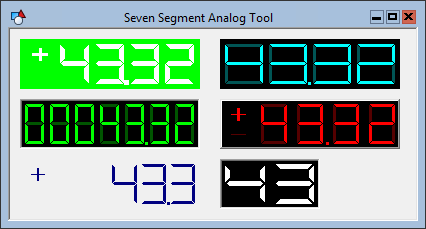
To associate the object with a point use the point identifier properties to form a fully qualified CygNet tag string. The point identifier properties are [1:SiteService], [2:Point ID], [3:Long Point ID], [4:Facility ID], and [5:UDC]. If the object is on a templated screen, only use the [5:UDC] property.
The DigitCount property specifies the number of digits to be displayed. If the value of the point overflows the display in the positive direction, then up arrows will be shown. If the value of the point overflows the display in the negative direction, then down arrows will be shown. The Precision property specifies the precision of the value. ShowSign can be used to indicate if the value is positive or negative.
The [AlarmElement] property can be set to show the point state color in the object’s Background Color, the Segment Color, or not at all (None). When set to None, the color specified for each component is shown. If set to one of the other options, the component color is replaced with the point state color.
The [UseCustomStateColors] property enables the object to use its own custom point state colors. If set to 1 - Yes, the colors used are those defined by the object’s [CustomStateColors] property. If set to 0 - No, the colors are those defined by the TheView’s [CustomStateColors] property.
More:
 Seven-Segment Analog Tool - Properties, Events, and Methods
Seven-Segment Analog Tool - ActiveX Properties

